


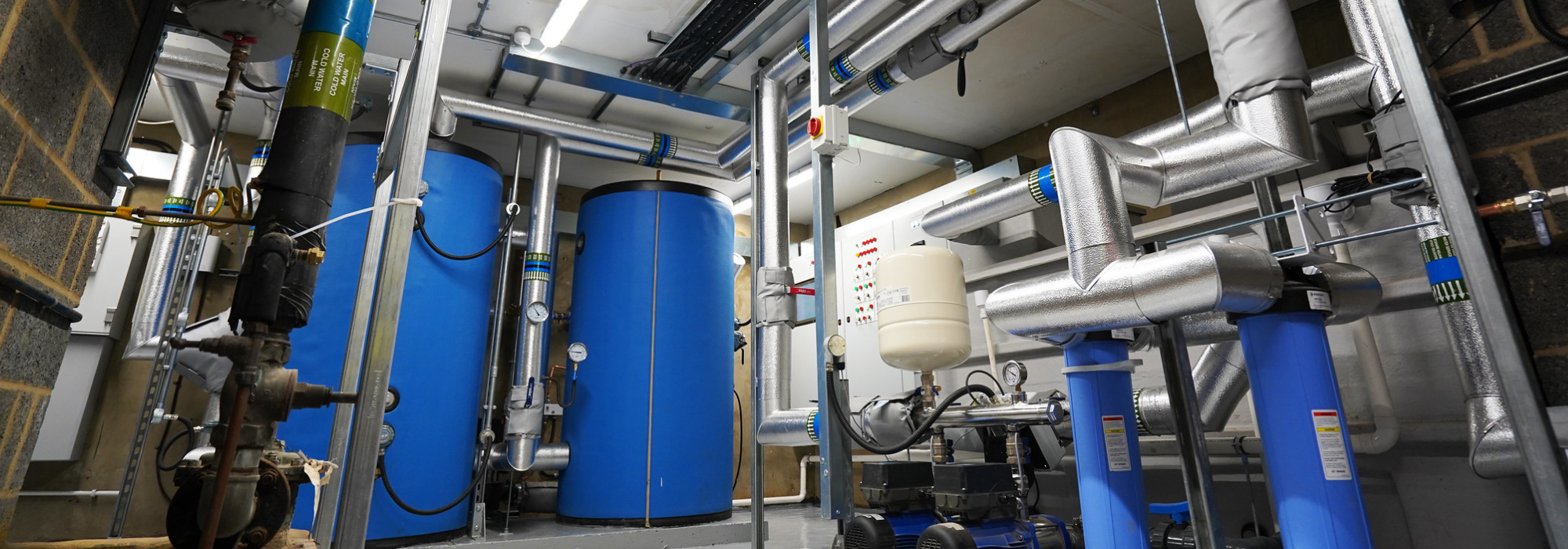
Heat Network Regulation Is Here - Is Your Organisation Ready?
Robbie McKinnon, Decarbonisation Manager, Axis CLC, March 2026, Regulation & Compliance
If your organisation manages communal or district heating systems — in residential blocks, sheltered housing, hostels or care homes — a significant regulatory change is now under way. For the first time, Ofgem has assumed authority over heat networks. The deadline to register is January 2027, and the penalties for non-compliance are substantial. But there is also grant funding available right now that can help you get ahead of it.
What Is Changing?
Heat networks have historically sat outside the regulatory framework that governs gas and electricity. Residents connected to a communal heat network had no ability to switch supplier, no price cap protection and limited recourse when systems failed or billing was unclear. That is now changing.
Under the Energy Act 2023, Ofgem has been granted powers to regulate heat networks in England and Wales. Interim consumer protections came into force in early 2026, covering billing transparency, complaints handling and support for vulnerable residents. The Heat Network Technical Assurance Scheme (HNTAS) — which sets mandatory technical performance standards — is being phased in from 2026 with full compliance required from 2027.
HNTAS requires operators to demonstrate performance across four areas: adequate metering and monitoring (including Automated Meter Reading linked to building management systems); reliable heat supply with documented maintenance and water quality; system performance below 400W per dwelling heat loss; and consumer outcomes including transparent billing and vulnerable customer support.
Who Is Impacted
Housing associations and local authorities are squarely at the centre of this. The regulation is designed to protect consumers with no alternative supplier — which describes the majority of social housing tenants on communal heating systems.
Many existing communal systems were installed in the 1960s to 1980s, operate on aging gas-fired plant, and have little or no metering in place. Systems that are already generating complaints, running hot, oversized for actual demand, or lacking a documented O&M programme are at particular risk of non-compliance.
The scale of the challenge varies significantly by organisation. For housing providers managing 20, 30 or 40+ communal heating sites, this is a portfolio-level programme management challenge, not just a site-by-site compliance task.
The Threat: What Non-Compliance Means
Ofgem has made clear this is a stick, not a carrot. The regulator can fine operators the higher of 10% of annual turnover or £1 million for failure to meet mandatory standards and consumer protection requirements. Enforcement can be triggered as soon as a resident formally complains to Ofgem — even before an operator has registered.
Beyond the direct financial penalty, non-compliance carries significant reputational and governance risk. Operators can have their authorisation revoked. And organisations that delay will face more expensive reactive remediation rather than planned, grant-supported improvement works.
The Opportunity: Grant Funding Available Now
Government has recognised that much of the existing heat network stock requires significant investment to reach compliance. The Heat Network Efficiency Scheme (HNES) provides grant funding specifically to help operators improve their systems — and it is available to social housing providers right now.
HNES offers two types of grants:
- 100% grant funding for optimisation studies on existing heat networks — typically worth £15,000–£30,000 per site and available at no cost to the operator.
- Up to 50% grant funding towards the cost of capital improvement works identified through the survey.
Crucially, HNES funding rounds open twice a year. Round 12 is expected to open in March 2026 and close in May. Round 13 is expected to open in August and close in October. This creates a practical pathway: a fully funded survey in the spring directly supports a capital grant application in the autumn — all within 2026.
What It Means For Your Organisation
For Asset Directors and Sustainability leads, the immediate priority is understanding your current position. Three questions matter most:
- Do you have a complete register of communal heat network sites, including plant age, fuel type, metering provision and recent outage history?
- What is your compliance gap? How many sites have AMR metering, Heat Metering, BMS data and documented maintenance programmes in place?
- Do you have a portfolio-level investment plan? Ofgem will expect evidence of a structured, improving programme — not a site-by-site reactive approach.
Beyond compliance, the regulatory programme presents a genuine opportunity to decarbonise ageing heating stock, reduce resident energy costs and improve service reliability — outcomes that align directly with broader sustainability commitments and resident welfare obligations.
How Axis CLC Can Help
Axis CLC is an established property services partner to housing associations and local authorities across England and Wales. Our in-house energy and decarbonisation team has direct experience delivering heat network surveys, funded improvement works and full decarbonisation schemes for social housing clients.
We support clients through every stage of the process:
- Portfolio review: using your existing condition surveys and outage data to identify highest-risk sites and build a prioritised programme — at no cost.
- Optimisation studies: 100% HNES grant-funded technical surveys producing an investable decision report, covering baseline assessment, root cause analysis and capital-costed interventions.
- Funding applications: supporting HNES capital grant applications alongside complementary funding routes including GBE, Salix, and regional programmes.
- Design and installation: full design and in-house M&E delivery of AMR metering equipment or smart solutions, heat pump systems (ASHP, WSHP, GSHP), Heat Interface Units (HIU), Reconfiguration of heat supply pipework. Pump or pipework replacement or removal, thermal storage, or tertiary system controls, through established procurement frameworks.
- Monitoring and O&M: post-handover monitoring platforms providing the data evidence Ofgem expects and enabling transparent, accurate resident billing.
A recent example: at Four Oaks Hostel for the Royal Borough of Kingston upon Thames Council, we removed aging gas plant across three buildings, installed an ASHP heat network with individual HIUs, deployed 49kWp solar PV with battery storage, and delivered real-time monitoring across the whole site. The result was a 50% reduction in carbon emissions and the elimination of site hot and cold spots that had been generating resident complaints. Total contract value: £658,000.
Act Now — The Funding Window Is Opening soon
With HNES Round 12 expected to open on the 30th March, and the January 2027 Ofgem registration deadline approaching, the time to engage is now. Organisations that secure survey funding this spring can have investment-ready reports in place for a capital application in August — and be significantly ahead of the compliance curve by the time HNTAS milestones begin to bite.
To find out where your portfolio stands, contact Robbie McKinnon, Decarbonisation Manager at Axis: axiseurope.com/contact